Overview
In this Learning Experience, learners are exposed to a range of Mi’kmaw perspectives on netukulimk and living in balanced relationship in Mi’kma’kik. Using historical and contemporary quotes and messages about Mi’kma’kik, learners will answer a series of questions about the quote in a carousel format. The carousel format is designed to create a reveal for the learners at its conclusion. A class discussion follows, allowing learners to consolidate and share their understandings.
Learners will...
- Immerse themselves in Mi’kmaw worldviews about landscapes, seascapes, plants and animals.
- Hear stories and messages about how land is honoured and valued.
- Be exposed to the deep, and for most people, spiritual, relationship the Mi’kmaq have with the land.
- Think creatively about what it means to be from a place over thousands of years.
- Learn about the transformations and changes that are a part of many Mi’kmaw stories.
Focus
Divide the class into groups of three learners. Each group is given a single worksheet that contains one quote, as well as four “windows.” Three of those windows will be covered with post-it notes until the group is ready to discuss their ideas. The three covered windows are where learners will express their individual thoughts; the group will use the fourth window to share their collective ideas.
Reading the quote at the top of the worksheet, each learner will answer the following questions:
- What does the quote mean to you?
- What does it say about how this person thinks about (or relates to) Mi’kma’kik?
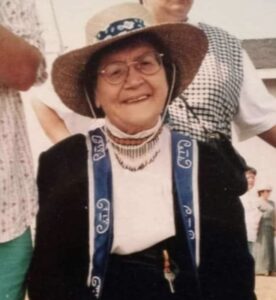
There is a belief that all trees, rocks, anything that grows is alive, [and] helps us in a way that no man can ever perceive, let alone imagine. — Rita Joe, writer and poet, 2008
Finally, learners will reveal all their answers and collaborate to reach consensus about their quote’s key meanings. The result of their collaboration will be summarized in the fourth window. Highlights from the group discussion can be shared with the class as a wrap-up. Ten worksheets are provided in the supplementary materials, which will support eight groups and up to 30 learners.
The quotes could be displayed with the maps of Mi’kma’kik created in LE F3: Our Land, Our Home.
PE!
It is important that learners have a clear understanding of the following content:
- The Mi’kmaq as the indigenous people of Nova Scotia and the Atlantic region.
- Mi’kma’kik as the ancestral homeland of the Mi’kmaq.
- The concepts of netukulimk and msɨt no’kmaq. (See LE F4)
Teacher Tip
Educators will need post-it notes for this activity!
LE Materials
COMING SOON!
 sharing our stories