Overview
In this audio learning experience, students will listen to various sounds from across Mi’kma’kik: birds, terrestrial and marine mammals, insects, waterfalls, rain, wind, and more! They will then be asked to identify the sounds. Teachers can use knowledge about these beings and their relationships to the particular habitats to enrich learner understandings about ms+t no’kmaq as well.
Learners will...
- Activate prior knowledge about various animals and habitats across Mi’kma’kik.
- Be exposed to new sounds, or learn to name sounds they hear in their everyday lives
- Associate specific animals and resources together with specific habitats.
- Understand that knowing Mi’kma’kik requires using all their senses.
- Understand that some species are “at-risk,” often as a consequence of human activity.
- Grow their listening skills (for many, learning to listen in a new way and in a new context).
Focus
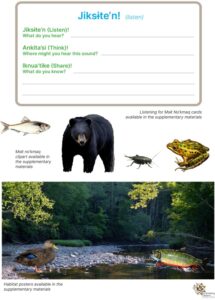
Learners listen to the tracks (see supplementary materials), and work to identify the sounds. When learners have identified the sound, they can find the associated image and attach it to the habitat scenes (see example). Note that each habitat group contains a variety of sounds: water, mammals, birds, insects, fish, and humans. After identifying the sound, learners can select their sound from the clip art and associate it with the appropriate habitat poster. Listening cards, msɨt no’kmaq clip art and habitat posters are all available in the supplementary materials.
Soundtracks are associated with one of five generalized habitats: a river in the interior mainland of Nova Scotia, a pond in Cape Breton, a woodland area in the Antigonish uplands, a coastal shoreline along the eastern Atlantic coast, and an estuary in the Annapolis Valley.
Sample class discussion questions to follow group work:
- Have you ever heard any of these sounds? Do you remember where?
- What are the habitats that these sounds come from? Let’s describe them.
- Can you name some places in Nova Scotia where these habitats are found?
- How might this habitat be important to the Mi’kmaq when European settlers first came to Mi’kma’kik?
- How might it be a part of netukulimk?
- How might this habitat be important to the Mi’kmaq today?
- What steps can everyone take to protect this habitat?
PE!
It is important that learners have a clear understanding of the following content:
- The Mi’kmaq as the indigenous people of Nova Scotia and the Atlantic region.
- Mi’kma’kik as the ancestral homeland of the Mi’kmaq.
- The concepts of netukulimk and msɨt no’kmaq. (See LE F4)
Teacher Tip
The concept of a habitat is important, and may need to be explored at the start.
LE Materials
COMING SOON!
Additional Resources
The Unama’kik Institute of Natural Resources has excellent videos and other content about animal (waisisk) species across Mi’kma’kik. See www.uinr.ca.
The Nova Scotia Department of Natural Resources has excellent information about Nova Scotia species, habitats and ecosystems, including species-at-risk, here and here.
 sharing our stories