
Introduction
In this section, learners will explore Mi’kmaw culture and community through a diverse set of Learning Experiences (LEs). While there is a great deal to share about Mi’kmaw culture and community, the LEs in this section focus on cultural values, orality, the centrality of family, and the practice of tpi’tnewey, that has endured through many generations. This section walks learners through Mi’kmaw decision-making processes during the Treaty-Making period and beyond. Importantly, the LEs in Family, Culture, Community support learners in identifying and reflecting upon widespread misconceptions about the Mi’kmaq.
Oral Traditions
Cultural values and Mi’kmaw worldviews come together in the culture’s oral traditions: the stories, practices, and histories passed on through the language from generation to generation. Stories and memory are foundational to Mi’kmaw culture. Oral traditions reflect community life and practice. Stories involve animals as family members, tricksters and friends. They mark places to gather resources such as plants and toolstones, and remind people who they are and have been.
The heart of Mi’kmaw oral tradition is the language. The language is rich with unique teachings, humour and worldviews. Complexities in the usage of sound or utterance can determine the meaning of emotions inherent in words such as love, disappointment, or humour. Language is sacred. Healing, for example, was supported by Mi’kmaw chants and songs. An oral culture uses many strategies to facilitate memory, including songs, stories, places, and repeated practices. In one LE, learners will be asked to use these strategies to sustain their own memories. Most of Mi’kmaw communication throughout history has been oral, but hieroglyphics, petroglyphs, and wampum also assisted with communications.
The Mi’kmaw language is distinguished from many others for being verb-based—meaning the language emphasizes an active or transitional state of being and existence. So, what would be understood as a noun in English, in Mi’kmaw, would be described for what it does rather than what it is. For example, the word for caribou is qalipu, meaning to shovel. The word emphasizes what the animal does, which is shovelling snow to get at mosses and plants underneath. Fun fact: The English name, caribou, comes from the word qalipu! Sometimes, people think of oral histories as fragile or changeable. But, as learners will come to understand, there would be no treaty rights without Mi’kmaw oral histories. Linked to language and place, oral histories are what have allowed the Mi’kmaq to maintain identity and community through many generations as well as through centuries of colonialism.
Values
Cultural values inform all aspects of life and interactions and are embedded in the language. Sometimes these values are easily recognizable, other times they are more difficult to identify. The values discussed below are not all-encompassing, but they do represent some of the primary values that guide many Mi’kmaw decisions and practices. Rather than seeing these values as standards, it would be more appropriate to see them as pathways to understanding Mi’kmaw life and history. Often understanding the values that inform decision-making helps all learners to build empathy and comprehension at a deeper level.
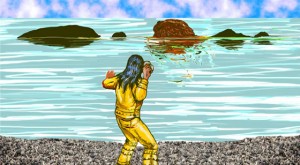
Artist Dr. Gerald Gloade imagines Kluskap, Kopit, and the birth of Five Islands.
Tpi’tnewey — Sharing is at the heart of the culture
Tpi’tnewey is one of the most important Mi’kmaw values and extends from food, to childcare, to land, and to resources. It is the practice of enthusiastically sharing meat or other resources without any expectation of immediate return, but it goes beyond that: sharing is a blessing. Tpi’tnewey is also honoured when a person does good things for others, and when people work together. Tpi’tnewey is an extension of the inter dependence of life and the respect for all things.
Act through consensus
Consensus has been the dominant mode of decision-making for Mi’kmaw communities for
generations. Beginning at the family level and extending to the governance districts of the Sante’ Mawio’mi (Grand Council), people seek consensus rather than majority rule whenever possible.
The close cousins of humility and humour
Humility and humour are related and important. In accepting one’s own fallibility as well as the challenging aspects of a difficult history, Mi’kmaq value laughing at themselves and laughing with others. Both aspects are essential in dealing with situations that might seem hopeless—helping people to either accept them or to transform them into something positive.
Mi’kmaw language is sacred
The Mi’kmaw language grew alongside and out of the lands, waters, and spirit of Mi’kma’kik and msɨt no’kmaq. It is a language that comes from a world always in flux, something that is abundantly clear in the very structure of Mi’kmaq itself. While English and French are languages built around the centrality of nouns, Mi’kmaw’s verb-dominant structure makes the relationship between the speaker and the world around them the most important part of speech. Mi’kmaw is distinctive, descriptive, and emotionally expressive. It contains knowledge and meaning that is difficult to understand when translated into other languages.The language is the foundation of Mi’kmaw culture,
history and worldviews.

Spirit is present in everything
Spirit is present in all of nature, in all of existence. This belief reflects the interdependence and flux of life, as well as the harmony all beings seek to maintain in the world.
Asa ki’l — Individuals do not interfere
Asa ki’l is the Mi’kmaw philosophy that recognizes that a person can make their own decisions. When a person has learned the philosophy of netukulimk and practices it in their daily lives, then they are the boss of themselves to do whatever it is they want to
do to help msɨt no’kmaq. Thinking this way allows people to do good for others, ensuring msɨt no’kmaq remain happy and healthy. As such, Mi’kmaq do not interfere in the lives or decisions of others. Rather than speaking directly to poor decisions or disagreements, many Mi’kmaq choose to teach through observation and metaphors. Sharing a comparative situation is one preferred way of teaching.
Respect everyone
All beings and all things deserve respect. Respect is learned and sustained through acknowledging and understanding the interdependence of everything— the plants, the water, the birds, the animals and people. Elders are held in highest esteem because they are assumed to understand best this interdependence and a person’s place within it.
Sweetgrass is sacred
Sweetgrass is considered an offering to the spirits. Woven into the fabric of daily life through ceremonies like smudging and the arts like baskets, it honours spirits all around us.
Care of children is everyone’s duty
Children are visible everywhere in Mi’kmaw communities. All adults are seen as caretakers of children, and people depend on family and community relationships to raise young people.
Oral Traditions: Strategies and Practices
Oral traditional societies use many strategies to create memories within and through generations. These are some that the Mi’kmaq have used since time immemorial:
- As in any culture, stories are narratives that may be historical or more allegorical—they might be event-driven or more legendary— but they always reflect the culture. Mi’kmaw stories are diverse and endless. Some stories act as maps of the landscape of Mi’kma’kik.
- Just like the Mi’kmaw language, Mi’kmaw oral stories are distinctive and descriptive, enacting life in Mi’kma’kik in vivid and deliberate detail.
- Songs or chants are a key strategy for memory—music is a mnemonic device and, for many, a spiritual practice.
- The Putu’s is a member of the Sante’ Mawio’mi (or Grand Council) who assists the nation with remembering key events and agreements.
- Wampum was used by the Putu’s as well as others to record events in a symbolic mnemonic, which was then “read” or interpreted when necessary.
- Placenames can also act as mnemonic devices by incorporating the features of a landscape or knowledge associated with that particular place.
- Petroglyphs are images etched into rock such as along the Bedford Barrens.
- Hieroglyphics are images that depict ideas or words and can be combined and recombined into new meanings.
Oral Histories are not Myths
Taller than the cliffs at Cape Split, Kluskap stands in the mud of the Minas Basin, glaring out at that ever-pesky Kopit (beaver), who swims around the Bay of Fundy, teasing and laughing, just out of reach. Kluskap’s been chasing Kopit all day. That giant beaver built a giant beaver dam and flooded Kluskap’s garden. Not to be outsmarted, Kluskap reaches down to the mud at his feet and whips five great globs of it at Kopit, trying to chase him away. Each of those mud-balls hits the water and forms an island. You can visit them today if you want to. Take a trip to Five Islands, Nova Scotia to see for yourself!
This famous Mi’kmaw story is often referred to as a myth. After all, giant beavers don’t exist—right? Not so fast!
Remember: Mi’kmaw people have grown up and changed with Mi’kma’kik over thousands of years, documenting the experience of living in Mi’kma’kik in oral histories to pass on to future generations. This means that some Mi’kmaw stories describe what Mi’kma’kik was like long before anyone with living memory was here. Mi’kmaq would have witnessed new islands come up from the water. But giant beavers?
Actually—yes! There really was a species of giant beaver that lived alongside the Mi’kmaq from 13,000 to at least 9000 years ago. These beavers (castoroides canadiensis) were up to 2.5m long and could weigh up to 200kgs!
To call Mi’kmaw stories “myths” is to deny the truths held within them. Mi’kmaw oral traditions are distinctive and descriptive— every detail serves a deliberate purpose and demonstrates the unfathomable depths of knowledge developed through countless generations in Mi’kma’kik. They hold important lessons about living in balanced relationship in Mi’kma’kik. They are maps. They are histories. They are ecological studies. They tell us who we are.
To explore more Mi’kmaw stories and see the genius within them, visit www.mikmaweydebert.ca.
 sharing our stories