Overview
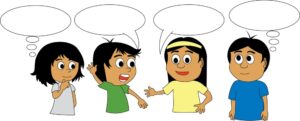
In this LE, learners are introduced to 12 key treaty terms and ideas. They are asked to absorb the meanings of the words through a creative dialogue experience. Dialogue bubbles are used to mimic the heavy reliance on discussion and negotiation at the heart of treaty-making. Learners imagine what people might think as well as what they might say.
Learners will...
- Grasp basic treaty vocabulary through a creative experience that emphasizes the social context of treaty-making.
- Be asked to use treaty terms appropriately within a scenario they imagine.
- See how other learners perceive the same primary terms.
- Be asked to consider what people are thinking at the same time that someone is speaking: the visible and non-visible aspects of discussion and dialogue.
- Apply their knowledge of social interaction and dialogue to convey meaning to others.
Focus
Twelve cards have been provided in the supplementary materials. Each card has one of the treaty terms on it, as well as a definition for that term and a blank dialogue image. Learners choose 1 card each and take a minute to absorb the term and what it means. Then, using the illustration on the reverse of their card, learners are asked to create a dialogue that demonstrates their understanding of the term. Learners who share the same term can find each other and compare their dialogues. These can also be shared in a class-wide discussion.
PE!
It is important that learners have a clear understanding of the following content:
- The Mi’kmaq as the indigenous people of Nova Scotia and the Atlantic region.
- Mi’kma’kik as the ancestral homeland of the Mi’kmaq.
- The concept of netukulimk and msɨt no’kmaq. (See LE F4)
Teacher Tip
An initial class discussion about the terms may be a useful start.
The terms for this LE are:
treaty, heir, alliance, signatory, right, responsibility, msɨt no’kmaq, netukulimk, negotiation, peace, promise, consensus, and ratification.
LE Materials
The materials below support this LE’s activities and knowledge growth. They are designed to be printed on both 8.5″x” and 11″x17″ paper.
Additional Resources
See the introductions to the What is a Treaty? and Treaty-Making sections, as well as the general introduction to the resource.
Website: Sister Dorothy Moore L’nu Resource Centre, “Treaties”
Website: Nova Scotia Archives, “Peace and Friendship Treaties at the Nova Scotia Archives”
 sharing our stories