The Truth and Reconciliation Commission of Canada (TRC) (2015) defines reconciliation as the process of “establishing and maintaining a mutually respectful relationship between Aboriginal and non-Aboriginal peoples in this country.” Does this sound familiar?
While the term “reconciliation” became popular fairly recently in the context of the residential school system, the concept isn’t new at all. In fact, as educators and learners working their way through this resource may have realized, reconciliation is built into the fabric of Mi’kmaw treaties. It is as old as Mi’kma’kik itself! This is why treaty education is so important. There can be no reconciliation without the treaties. Being a treaty person is understanding that reconciliation is everyone’s responsibility, because Treaty Denial impacted everyone.
Reconciliation and Residential Schools
Reconciliation is required for healing from Treaty Denial in its entirety, but most Canadians link the concept to residential schools. In 2015, at the end of a seven-year inquiry into the abuses and impacts of the Indian Residential School system, the TRC released its multi-volume final report. The report concluded that Canada had committed cultural genocide. For the first time on a grand scale, Canadians were forced to reckon with this key pillar of Treaty Denial, and the fact that the Canadian government and various Christian churches orchestrated it with the support of the Canadian public. The truths of the residential school system are now hard to ignore, especially when its legacies remain starkly visible today. But the story cannot end with simply knowing what happened.
Key to the TRC’s final report was the release of 94 “Calls to Action” that created a road map for Canadians and Canadian institutions to begin the process of healing from the trauma of the residential school system and repairing relationships that Treaty Denial broke. These Calls to Action form Canada’s foundation for reconciliation. They can work alongside the treaties.
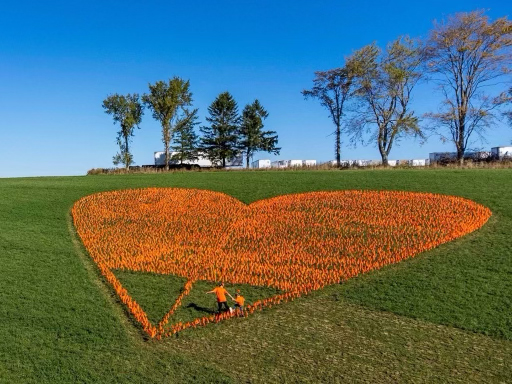
This beautiful arrangement of flags was made to honour residential school survivors at the site of the former Shubenacadie Indian Residential School on the National Day for Truth and Reconciliation in 2021. (Photo: Len Wagg)
Reconciliation is an Action
Reconciliation cannot be achieved without learning about the past and acknowledging the harms that indigenous peoples have experienced because of Treaty Denial. But communities must also take action by working together to understand how to live as treaty people. Reconciliation isn’t just something to learn about. It’s something to do.
The Learning Experiences (LEs) in this section unpack both the whys and the hows of reconciliation through a focus on the historical and contemporary impacts of the residential school system in Mi’kma’kik, as well as on the actions that all treaty people can take to begin, or continue, the walk toward healing in their own communities. Learners will define what reconciliation looks like to them, strengthen the skills required to identify the kinds of attitudes that drove Treaty Denial in the first place, and understand that when they work together, they have the capability to carry reconciliation forward, ensuring a better world for future generations.
What is Cultural Genocide?
The Truth and Reconciliation Commission of Canada (2015) defined cultural genocide in its final report:
“Cultural genocide is the destruction of those structures and practices that allow the group to continue as a group. Land is seized, and populations are forcibly transferred and their movement is restricted. Languages are banned. Spiritual leaders are persecuted, spiritual practices are forbidden, and objects of spiritual value are confiscated and destroyed. And, most significantly…families are disrupted to prevent the transmission of cultural values and identity from one generation to the next. In its dealing with Aboriginal people, Canada did all these things.”
 sharing our stories