Learning Experience: Koqwe’l Net A’tukwaqnn (What are Stories?)
Overview
NOTE: This Learning Experience will update as more Mi’kmaw History Month material is released!
A’tukwaqnn (Stories) (pronounced AH-toog-wah-han) are a primary way of teaching in Mi’kmaw culture. It is through a’tukwaqnn that important traditional and ancestral knowledge is passed on through countless generations. As such, it is important to know what a’tukwaqnn are and how to honour them. It is difficult to answer the question, “koqwe’l net a’tukwaqnn” (what are stories?) though, without letting a’tukwaqnn speak for themselves.
As Elder Murdena Marshall shares, a’tukwaqnn are living knowledge. A’tukwaqnn have spirits; they are our relatives too. When a’tukwaqnn are shared, a’tukowinu’k (storytellers) (pronounced AH-too-go-wee-noog) and listeners are in a relationship with the spirit of the a’tukwaqn (story). This relationship must be cared for and respected, just like any other relationship. When we respect and take care of a’tukwaqnn, our relationship strengthens; a’tukwaqnn continue to teach us. This is what living knowledge is.
In this Learning Experience, participants will listen to and learn with the four a’tukwaqnn that anchor the 2025 Mi’kmaw History Month poster, each one carrying important teachings about Mi’kmaw culture and life in Mi’kma’kik. Participants are asked to consider what it means to respect and take care of these a’tukwaqnn, and to either begin, or grow their learning journey with each one.
Learners will…
- Engage with the idea of a’tukwaqnn as living knowledge, as relatives to be respected and taken care of.
- Understand that a’tukwaqnn teach about life in Mi’kma’kik in distinctive and descriptive ways.
- Understand that a’tukwaqnn cover vast topics such as environmental science, space, history, language and more—and that they often cover multiple interconnecting topics at once.
- Recognize that a’tukwaqnn carry thousands of years of important knowledge about living and thriving in Mi’kma’kik.
- Encounter, or strengthen their understanding of Mi’kmaw ways of learning and sharing knowledge, including key concepts such as: msɨt no’kmaq, netukulimk and etuaptmumk.
- Grow comfortable with expressing where they are in their learning journey with less worry about a “right” or “wrong” answer, building trust in themselves and strengthening community relationships.
Focus
NOTE: Educators know their learners best—this LE can be adapted in many different ways to meet learners where they’re at.
Before listening to a’tukwaqnn, educators will begin with a brief introduction about Mi’kmaw storytelling (additional support for this introduction can be found in the supplementary materials) to establish context for the activity.
Learners are then asked to listen to one of the Mi’kmaw History Month a’tukwaqnn (see supplementary materials) one time through.
When they are finished, learners take a few moments to consider what they think and feel about what they have heard. This time does not have to be silent or still, but it is important to leave space between listening to the story and talking about it.
Learners will then share, either as a large group or in smaller groups, what a’tukwaqn made them think about or feel. How learners share their thoughts is up to them. For example, someone could share their experiences orally, visually, or even physically. Encourage them to share the way that makes the most sense to them— the possibilities are endless!
With support from the the supplementary materials, educators will then expand on a’tukwaqn. It is important to note that much of the supplementary materials provide visual resources that demonstrate some truths or lessons in each a’tukwaqn rather than laying everything out explicitly. A’tukwaqnn should be able to come to life on their own; this LE is less about explaining the “right” things to look for in each one as it is about letting learners observe for themselves what a’tukwaqnn are teaching and to draw their own conclusions. Learners may share ideas or images that don’t “match up” with what is in the supplementary materials. This is okay. The supplementary materials are there to support, but not to serve as a definitive explanation about what a’tukwaqnn themselves mean.
Finally, learners will listen to the same a’tukwaqn one more time. Ask them to consider whether their experience with it has changed, or remained the same.
An optional continuation of this exercise that allows learners to engage with a’tukwaqnn in ways that are strongly practiced in Mi’kmaw communities is to share the same a’tukwaqn again after a longer period of time has passed. This leaves time for everyone to observe the world around them after hearing a’tukwaqnn. Being in relationship with a’tukwaqnn this way is to engage in Mi’kmaw ways of learning in community.
PE!
It is important that learners have a clear understanding of the following content:
- The Mi’kmaq as the indigenous people of Nova Scotia and the Atlantic region.
- Mi’kma’kik as the ancestral homeland of the Mi’kmaq.
- The concept of netukulimk and msɨt no’kmaq. (See Roots of Reconciliation LE F4)
- The concept of etuaptmumk. (Learn more here)
Listen to A’tukwaqn:
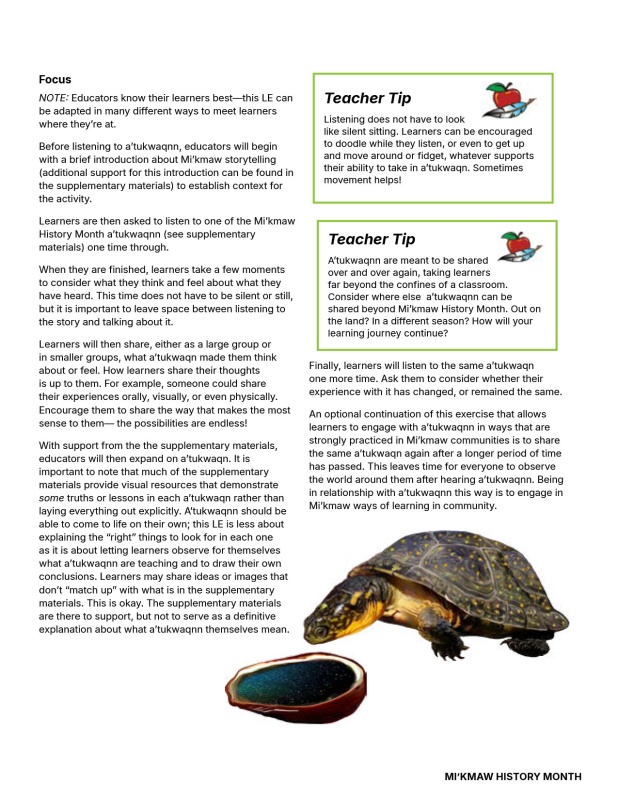
Listen to Elder Gerald Gloade tell the story about Skɨte’kmujuawti Mikjij (Spirit Road Turtle) here.
Listen to Elder Barbara Sylliboy tell the story about Ki’kwa’ju here.
Listen to an audio recording of Muin and the Seven Bird Hunters in Mi’kmaw and English, only English, or en Français.
Listen to an exclusive version of Elder Barbara Sylliboy sharing the story about Aplikmuj here.
Teacher Tip
This LE is about building a relationship with a’tukwaqnn, and either starting or strengthening a learning journey. There are no “wrong” things a learner could say about what a’tukwaqnn made them think about. A person’s place in their journey— wherever they are on that path—is to be recognized and honoured. To encourage learners not to worry about giving a “wrong” answer, educators can remind participants that each learning journey is unique and valuable. How can each learners’ strengths be honoured?
Teacher Tip
Listening does not have to look like silent sitting. Learners can be encouraged to doodle while they listen, or even to get up and move around or fidget, whatever supports their ability to take in a’tukwaqn. Sometimes movement helps!
Teacher Tip
A’tukwaqnn are meant to be shared over and over again, taking learners far beyond the confines of a classroom. Consider where else a’tukwaqnn can be shared beyond Mi’kmaw History Month. Out on the land? In a different season? How will your learning journey continue?
 sharing our stories