
Overview
Using provided content, as well as the Mi’kmaw Place Names Atlas website, Google maps and other online resources (provided), learners will explore a place within one of the seven Mi’kmaw districts. Together, they will gather the places to create a classroom map as well as an atlas that will showcase the extraordinary beauty and great diversity of Mi’kma’kik. Both the atlas and the map will be useful reference resources for future LEs. Learners will explore ancestral places, story places, habitats, waterways, and communities, and will learn where some of these key places can be found.
Learners will...
- Familiarize themselves with the geographic and cultural landscapes of Mi’kma’kik.
- Be introduced to some aspects of the Mi’kmaw worldview as they relate to place, and what place is.
- Know one place and its district in more detail as well as become familiar with the seven Mi’kmaw districts.
- Use maps and map legends.
- Gain greater self-awareness about what they know and don’t know, activating prior learning.
- Understand that communities have changed through time, but that all are related.
- Encounter different configurations of community through time.
- Begin to grasp the nature of the autonomy/independence as well as the relatedness among Mi’kmaw communities.
- Extract information from given sources and then represent that information anew.
Focus
Each learner is provided with one “Mi’kma’kik Place Card,” which they will use to explore Mi’kma’kik in more detail. The place cards provide websites as well as other known names of places (for searching online).
After exploring their places, learners use the worksheet to synthesize their findings. The provided map graphics are designed so that they can be assembled as a large puzzle for the classroom wall. Each learner will create their own map icon on their worksheet that can be placed on the large classroom map. The worksheets can then be gathered into a group to create a map atlas. Both the atlas and the map will be useful reference resources for future LEs. All graphic files are formatted to fit on 11 x 17 inch paper.
Why are there nine maps, but only seven districts?
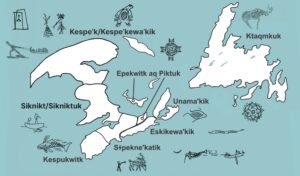
You might notice that the individual districts of Unama’kik aq Ktaqmkuk, and Epekwitk aq Piktuk have been split into two maps. This was a deliberate choice designed to make this activity more manageable in the classroom, allowing learners to be able to look more deeply at different habitats and ecological zones.
PE!
This is an introductory unit —it should be appropriate for all learners regardless of prior knowledge.
This is a great activity for learners who are new to the concept of Mi’kma’kik as the Mi’kmaw homeland!
Teacher Tip
This LE encourages learners to think about the places around them as Mi’kmaw places. These map outlines are to give learners a rough idea of where important places are, and are not meant to be taken as definitive representations of Mi’kmaw districts. See the introduction to this section for more information on how maps were approached in this resource.
LE Materials
The materials below support this LE’s activities and knowledge growth. They are designed to be printed on both 8.5″x” and 11″x17″ paper.
F3-Our Land, Our Home Materials (map pieces)
Additional Resources
See the introduction to this section for a description of Mi’kma’kik as well as discussion on the concepts noted above (Mi’kma’kik and seven Mi’kmaw districts).
 sharing our stories