Introduction
The United Nations (UN) is an international organization of 193 Member States that seeks to address global issues affecting humanity. Among other things, it sets the standards for human rights. One of the ways the UN sets these standards is through the development of conventions, treaties and declarations that countries can use to shape their own laws. Countries must formally sign or adopt the conventions, treaties or declarations for them to apply; the UN cannot force a country to adopt any of its standards.
For indigenous rights, the UN standard is the United Nations Declaration on the Rights of Indigenous Peoples (UNDRIP). Drafted over the course of nearly 25 years by indigenous peoples and allies from around the world and officially adopted by the UN in 2007, UNDRIP defines indigenous rights and provides a framework for state governments to address those rights at home. While one might think about treaties and UNDRIP as two separate entities, the story of Treaty Denial and Renewal in Mi’kma’kik and the story of UNDRIP are tightly intertwined. Mi’kmaw people and their allies were some of the key architects of UNDRIP, and leaders who advocated for indigenous rights at the UN were also advocating for Treaty Renewal at home.
The Learning Experiences (LEs) in this section are designed to place Treaty Renewal in Mi’kma’kik into a global context and to demonstrate the ways Mi’kmaw leadership recognized that their struggles during Treaty Denial were linked to the struggles of indigenous peoples globally. They also highlight how Mi’kmaw values influenced UNDRIP’s development, and show learners the important role UNDRIP plays in our collective reconciliation journey today.
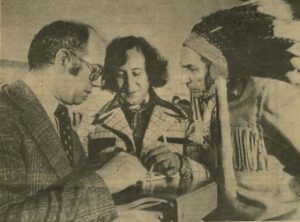
Following Mi’kmaw treaty protocol, the position paper was presented in ceremony. In that ceremony, Kji-Keptin Alexander Denny (middle) and Kji-Saqmaw Donald Marshall Sr. presented Minister of Indian Affairs Warren Allmand with a gift. (Courtesy of Owen Fitzgerald, Micmac News, vol. 6, no. 5, May 1977, p. 1)
The Sante’ Mawio’mi goes to the UN
When considering the advocacy that led to Treaty Renewal in Mi’kma’kik, it is important to understand that the Mi’kmaq were not operating in a bubble. In fact, it was Treaty Denial that brought Mi’kmaq to the United Nations in the first place. It was also what would eventually get the Nation involved in UNDRIP’s development.
In 1977, the Union of Nova Scotia Indians, an organization representing, at the time, 11 bands in Nova Scotia, presented a position paper to the Minister of Indian Affairs demonstrating that Mi’kmaq had Aboriginal and Treaty rights in Mi’kma’kik. (For a refresher on Aboriginal and Treaty Rights, see the introduction to the Treaty Renewal section.)
Despite overwhelming evidence that would later be affirmed by the Supreme Court, the Canadian government rejected the claim outright, stating that Mi’kmaw Aboriginal and Treaty Rights had been “superceded by laws passed by various colonial and provincial governments.” They denied that Mi’kmaq had ever given up their rights to Mi’kma’kik.
In response, Kji-Keptin Alexander Denny took Mi’kmaw concerns to the UN Human Rights Committee on behalf of the Sante’ Mawio’mi. There, he made it clear that Canada had continuously denied the Mi’kmaw Nation the right to self-determination, violating the United Nations International Covenant on Civil and Political Rights.
Unfortunately, the UN would not address the Kji-Keptin’s claim. The Human Rights Committee was designed to protect the rights of individuals, not the rights of a collective. The UN’s very structure made it impossible to recognize the Mi’kmaq as a distinct people with distinct rights.
The Sante’ Mawio’mi’s experiences at the United Nations brought Mi’kmaq into contact with indigenous people from around the world who had also come to advocate for their own rights. They could see that a declaration that defined and protected indigenous peoples’ collective rights worldwide was needed. The UN Working Group on Indigenous Peoples (WGIP) formed in 1982, and began developing what became UNDRIP three years later.
UNDRIP and Treaty Renewal
The WGIP started drafting UNDRIP in 1985, the same year that the Supreme Court of Canada affirmed the validity of the Treaty of 1752-53. This landmark decision, which came out of the R v. Simon court case, is generally recognized as the beginning of the Treaty Renewal period in Mi’kma’kik.
The relationships Mi’kmaq built with other indigenous peoples at the UN helped shape how they navigated Treaty Renewal at home. In turn, Mi’kmaq shared what they had learned from advocating for Treaty Rights in Canada with other nations experiencing similar struggles. These discussions shaped UNDRIP’s very development.
The Push for Self-Determination
It would take nearly 25 years of negotiations and multiple drafts for UNDRIP to reach the ratification stage at the United Nations. Achieving UN-wide consensus on what indigenous rights were, without losing sight of what indigenous peoples were advocating for, was difficult.
Out of the numerous political, economic, cultural, and language rights that UNDRIP covers, one of the Declaration’s most foundational protections is the right of indigenous peoples to collective self-determination. It also proved to be among the hardest-won.
Many UN Member States, Canada included, felt that recognizing indigenous peoples’ right to self-determination undermined their own. Self-determination was close to being cut from UNDRIP at multiple points during the process. The irony, or perhaps arrogance, of colonial nations being unwilling to acknowledge the sovereignty of indigenous nations on whose lands their countries were built was not lost on the indigenous representatives and their allies at the United Nations.
But collective self-determination remained important to indigenous peoples around the world. This was a right that needed protection, regardless of how UN Member States felt about it. Mi’kmaw voices proved crucial in achieving the working group’s goals.
Mi’kmaw leaders like the late Kji-Keptin Alexander Denny understood self-determination not through a western worldview, but through a Mi’kmaw worldview. According to Russel Barsh, a lawyer working for the Sante’ Mawio’mi, Mi’kmaq recommended that the Declaration frame self-determination not as a “right” the way the western world understood it, but as the collective responsibility indigenous peoples had to govern
themselves.
This idea of self-determination was clearly informed by Mi’kmaw concepts like msɨt no’kmaq and netukulimk, but many of the other indigenous nations involved with UNDRIP had similar understandings of the world and agreed with the suggestion. By recognizing that indigenous peoples had the right as peoples to determine what their own responsibilities were, UNDRIP could protect indigenous peoples’ right to live in a way that ensured balance for all. This framing had exactly the effect that UNDRIP writers hoped. Collective self-determination would be included in the final draft.
Canada and UNDRIP
Four countries, including Canada, voted against UNDRIP when the UN General Assembly officially adopted it in 2007. The Mi’kmaq, and other indigenous peoples who shared their territories with Canadians, were denied the fundamental right to collective self-governance. It would take another nine years of indigenous and allied advocacy to get the Canadian government to reverse their decision and ratify UNDRIP.
Residential School survivors and the Truth and Reconciliation Commission likely played an important part in Canada’s change-of-heart. After decades of advocacy from survivors, in 2008, the Canadian government officially apologized for the residential school system. They launched the TRC that same year. In 2015,= the TRC released its Final Report and the 94 Calls to Action, which called on the Canadian government to adopt UNDRIP fully (Call to Action #43) by entrenching it into Canadian law.
This global chapter in Treaty Denial and Treaty Renewal shows us not only that the fight for indigenous rights is much bigger than Mi’kma’kik, but that when people work together, they can make an impact that reaches far beyond themselves.
What is UNDRIPA?
Canada’s ratification of UNDRIP in 2016 was an important milestone, but it was not the end of the journey. UN Declarations cannot force states to make changes to their own laws; Canada had to choose to make UNDRIP official by writing it into Canadian law. Similarly to the difficulties UN Member States had in recognizing indigenous self-determination, Canada struggled with taking the next step. They had to recognize that many of the legal structures Canadians took for granted actively infringed upon indigenous rights.
Just as they had done in the decades previous, indigenous peoples and their allies in Canada worked hard to advocate for the adoption of UNDRIP into Canadian law. Finally, in 2021, their work paid off with the passing of the United Nations Declaration on the Rights of Indigenous Peoples Act, or UNDRIPA. Learners can explore what has happened with UNDRIPA in the years since in a Learning Experience in this section called “UNDRIPA Check-In” (LE RR11).
 sharing our stories