Treaty-Making 101
The Peace and Friendship Treaties made between the Mi’kmaq and the British are often referred to as the Covenant Chain. They are called this because the Peace and Friendship Treaties all share a common core that links them together. All the treaties include a few key promises: the Mi’kmaq would allow already-existing British settlements to remain; they would allow trade within their territory (Mi’kma’kik); and conflict that arose between Mi’kmaq and settlers would be resolved by both Mi’kmaw law and British law, depending on the situation. For example, if Mi’kmaq caused harm to the British, Mi’kmaw law applied. If the British caused any harm to the Mi’kmaq, British law would apply.
The Covenant Chain began with the 1725 (ratified to 1728) treaty, and each one that followed would build off of the last. The rest of the Peace and Friendship Treaties renewed the 1725-1728 Treaty — albeit sometimes with additional elements. Some treaties freed prisoners (1725, ratified to 1728); some established Treaty Day (1752, ratified to 1753); some had few signatories (1749) and others had many (1760, ratified to 1763).
A Few Essentials
In teaching about treaties, it’s important to remember a few essentials:
- Treaties are between two or more sovereign nations. They acknowledge the operation of two for more distinct legal systems. The Peace and Friendship Treaties are part of both Mi’kmaw law and British law.
- The Mi’kmaq delegated to the British Crown certain rights in their territory that benefited the British subjects.
- The Mi’kmaq never ceded any resources or territory to the British Crown. They permitted lawful British settlements under Mi’kmaw law.
- Under Mi’kmaw law, the Saqmaq (Chiefs) of each district had authority to enter into treaties. Therenewal and ratification of the 1725-28 Treaty
occurred through the 18th century until 1779. The more signatories a treaty had, the greater its geographic and political scope. - The motivations to sign treaties were different. The British Crown needed Mi’kmaw consent to create settlements and to trade. The Mi’kmaq worked to protect netukulimk and to adjust to the presence of British settlers in Mi’kma’kik.
The British also sought to enhance their existing relationship with the Mi’kmaq and to neutralize the Mi’kmaw alliance with the French, which was a powerful force in the 18th century. - The treaties between the Mi’kmaq and the British are living documents signed without end dates. The phrase they use to describe the time frame of the written agreement is “their heirs and the heirs of their heirs forever.”
- The treaties are not just “Mi’kmaw” treaties. They bring the British into the Mi’kmaw Law of Relationships. Mi’kmaw treaties are treaties that establish rights and responsibilities for all Canadians in Mi’kma’kik. This is what the phrase
“we are all treaty people” means. - British efforts to claim Mi’kmaw land and resources for exploitation and settlement generated conflict with the Mi’kmaq, who fought to protect msɨt no’kmaq and uphold netukulimk. Mi’kmaw sovereignty and military strength in the 1700s are often poorly understood and almost always understated. The reality is that Mi’kmaq were the only ones who knew the interior of Mi’kma’kik. The Nation managed alliances with the French and English very skilfully. From this position of strength, Mi’kmaq compelled the British for many decades to sign treaties and end wars England could not win. Ultimately, the British succeeded with land taking through an aggressive effort to populate Mi’kma’kik with emigrants from New England and Great Britain. Loyalists, Planters and others all played a role in the displacement of communities and the disruption of netukulimk.
- After the last treaty was signed in 1779, the British began to ignore these existing treaties and their responsibilities. This was very much unlike the Acadians who managed a (mostly) respectful and complementary way of life in Mi’kma’kik. To a large extent, Acadians honoured the reciprocal practices at the heart of netukulimk. The Mi’kmaq experienced the British removing large quantities of resources (fish and wood primarily) without ever returning resources to Mi’kma’kik. In 18th century Mi’kmaw culture, raiding another’s hunting ground was a declaration of war. So, while the British simply saw their fishing and lumbering practices as economic activity, for the Mi’kmaq, this British activity was unauthorized, hostile and destructive. Keeping promises and honouring the Mi’kmaw Law of Relationships were essential for maintaining peace and friendship.
- The Supreme Court of Canada has affirmed that the Peace and Friendship Treaties are valid multiple times since 1985. It is legally very clear that each party must keep their promises.
- Mi’kmaw kept the promises of the Peace and Friendship Treaties alive during the Treaty Denial period. Without these oral histories, which persisted through two centuries, there would be no treaty rights today.
- The repatriation of the Constitution to Canada from Great Britain in 1982 marked an important moment in which the promises made in the 18th century were explicitly and legally transferred to the Government of Canada.
- Since 1985, the Supreme Court of Canada has repeatedly affirmed the 18th century treaties as enforceable and binding. These cases mandate the Treaty Rights process and decisions.
A Treaty-Making Timeline: 1720 to 1780
The Treaty-Making period is characterized by repeated attempts to reach peaceful agreements and to re-establish the relationship between the Mi’kmaq and the British. If the 1725-28 Treaty set the groundwork for the relationship, new treaties became required as events changed the conditions of the original agreements. For example, the arrival of 2500 British colonists and hundreds of troops to Kjipuktuk (Halifax) in 1749 signalled a change in British intentions and exacerbated tensions that
had grown through the preceding decade. The establishment of Halifax paralleled a shift to a much more aggressive British colonial policy resulting in the Acadian Expulsion, among other events. Despite the Treaty of 1752-53, these developments put the treaty relationship in jeopardy for more than a decade; the relationship was reaffirmed by the 1760-63 Treaty. Brief descriptions of key treaties follow below:
Treaty of 1725 (ratified to 1728)
This was the first Peace and Friendship treaty between the Mi’kmaq and the British Crown. It incorporated the proposed Wabanaki compact that was negotiated in Boston, Massachusetts in the fall of 1725, which was then renewed, ratified and confirmed over a number of years across the districts of Mi’kma’kik. These treaties meant that the British sovereign acknowledged Mi’kmaw hunting, planting and fishing rights. The 1725-28 Treaty is the main focus of a great readers’ theatre in this level! (See LE T4). It is this treaty that anchors future negotiations, and it is notable for its large number of signatories (at least 77 during the ratifications).
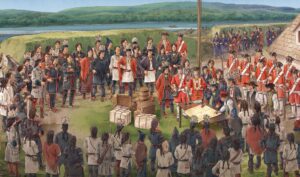
Artist’s rendering of the ratification of the 1725–1728 Treaty at Fort Anne National Historic Site in June 1726. (Courtesy of Parks Canada)
Treaty of 1752 (ratified to 1753)
This treaty was a renewal of the 1725-28 Treaty, and was signed by a small number of Saqmaq, including Saqmaw John Baptiste Cope, and Governor Hopson of Nova Scotia. The Treaty of 1752-53 was made as a response to growing hostilities between the Mi’kmaq and the British in the wake of British settlement in Halifax and greater British ambitions in Mi’kma’kik. The Saqmaq who signed the 1752-53 Treaty lacked broader support from many other Saqmaq due to the ongoing conflict with the British and growing mistrust across Mi’kma’kik. As with other Peace and Friendship Treaties, the 1752-53 Treaty promised “(F)ree liberty of hunting and fishing as usual” as well as protected trade with the British. The Treaty of 1752-53 established October 1st as Treaty Day and provided instruction on the annual renewal of promises between the British and the Mi’kmaq. Saqmaq from Le Have and Cape Sable joined in 1753, an important development at the time.
The Supreme Court of Canada upheld this treaty during the 1985 James Simon case (R v. Simon), marking the first time Canada acknowledged the legal validity of Mi’kmaw treaty rights. This was a particularly important moment for Treaty Renewal, as the 1752-53 Treaty was denied just fifty-seven years earlier when the Province of Nova Scotia wrongfully convicted Kji-Saqmaw Gabriel Sylliboy of hunting out of season, despite his argument that the treaty protected his right to hunt. Nova Scotia would apologize for this decision, reversing it and granting the Kji-Saqmaw a free pardon in 2017.
Treaty of 1760 (ratified to 1763)
This Mi’kmaw treaty is a renewal of the terms of the 1725-28 Treaty. Signed by a large group of Saqmaw over multiple years, the Treaty of 1760- 63 significantly marked the end of more than a decade of hostilities with the British. The British promised not to hinder Mi’kmaw hunting, fishing and gathering. In return, the Mi’kmaq promised not
to bother the British in their settlements. Just like all previous treaties, the Mi’kmaq did not cede land or give up other rights. This is also the treaty upheld by the Supreme Court of Canada during the 1999 Donald Marshall Jr. fishing case. (R v. Marshall)
1763 Royal Proclamation
The Royal Proclamation of 1763 is an important document in treaty history. In it, King George III claims the areas of North America won by Britain during the Seven Years War (1754-1763), but states explicitly that indigenous lands would remain indigenous lands until ceded by treaty. The Proclamation is often used to support Aboriginal Title—the assumed title for indigenous homelands by indigenous people at the time of contact regardless of land use practices.
The Watertown Treaty (1776)
The Mi’kmaq made one treaty with the United States in 1776, called the Watertown Treaty. The Watertown Treaty established relationships between Saqmaq and the new government of the United States. In it the United States promised to approach their relationship with the Mi’kmaq more as the Acadians did rather than as the British had at the time.
1779
This is the last treaty signed with the British. It affirms the previous treaties and includes the Siknikt/Sikniktuk and Kespe’k/Kespe’kewa’kik districts in New Brunswick and Quebec. It marks the end of open hostilities between the British and the Mi’kmaq during the American Revolution.
We Are All Treaty People
Since 1985, the Supreme Court of Canada has repeatedly reaffirmed the validity of the 18th century treaties. The court cases arising from Mi’kma’kik have become an established part of Canadian law, and have affected Aboriginal and Treaty Rights for indigenous nations across the country.
The phrase “We Are All Treaty People” has become widespread. It reflects simply that both Mi’kmaq and Canadians are part of the treaty relationship. Both groups have rights, and both groups have responsibilities. These rights and responsibilities continue to the present day and will continue into the future.
Because the treaty relationship was disrupted for two centuries, there is now work to be done to determine what that relationship means. The modern treaty rights process is focused on this work; it involves Mi’kmaw, Federal and Provincial governments.
Which Treaty? 1725? 1726?
While the treaties are generally referred to by one year or another, most of them are signed over a number of years. Because individual Saqmaw were the sole authority for their community, no one Saqmaw could sign a treaty for another. This meant treaties had multiple signatories and took a number of years to ratify. For example, when someone talks about the “1726” Treaty, they are actually referring to the treaty signed in Boston in 1725 with indigenous leaders there, and then ratified by various Saqmaq across Mi’kma’kik in 1726, and 1727, and 1728. The same is true for the 1760 Treaty, where the ratification continued until 1763. The naming conventions often create confusion for modern learners.
Mi'kmaw Law of Relationships
Mi’kmaw treaty-making did not begin in 1725. By that point, Mi’kmaq were treaty experts. When Europeans arrived in Mi’kma’kik, they entered a world ordered by treaties, and when the British signed treaties with Mi’kmaq later, they were entering agreements guided by the Mi’kmaw Law of Relationships. The Law of Relationships emerges from an acceptance and acknowledgement that all of existence is interconnected. This is where the practice of saying msɨt no’kmaq (“all my relations”) comes from.
Establishing and maintaining relationships among msɨt no’kmaq is at the heart of treaty- making. The intent of Mi’kmaw treaties is to hold all beings in relationship with one another whether they recognize it or not. The key is constantly working to ensure the
relationships are good.
Mi’kmaw treaties are not just one-time formal agreements. Treaty is a foundational part of how we live our lives in Mi’kma’kik. The Law of Relationships asks that everyone works together every day to foster deeply loving and trusting relationships with msɨt no’kmaq so that everyone can thrive in a balanced way. An important part of taking care of our relationships is making a deliberate and dedicated choice to repair them when they are damaged, even when this work is difficult.
 sharing our stories