Overview
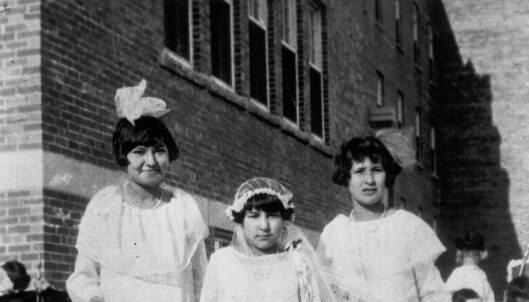
This Learning Experience uses a gallery walk format that includes discussion and feedback to introduce learners to primary facts about the Shubenacadie Indian Residential School. The gallery is punctuated and organized with five primary statements: 1) Many families were forced to send their children to residential school; 2) Residential schools punished children for practicing their culture or speaking their language; 3) Many children lost their language and parts of their culture at the residential schools; 4) Most children were not happy or healthy at the residential schools; 5) The residential school affected many generations of Mi’kmaw people.
Learners will...
- Engage their understanding of residential schools with a range of images and content.
- Understand central aspects of the residential school experience, including its origins, intentions, and outcomes.
- Appreciate the impacts of the residential school such that they can understand the need for a national reconciliation effort.
- Be asked to explore why Canada created the residential schools.
- Understand the residential school system as a key part of the Treaty Denial era.
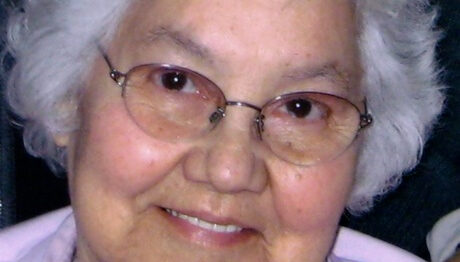
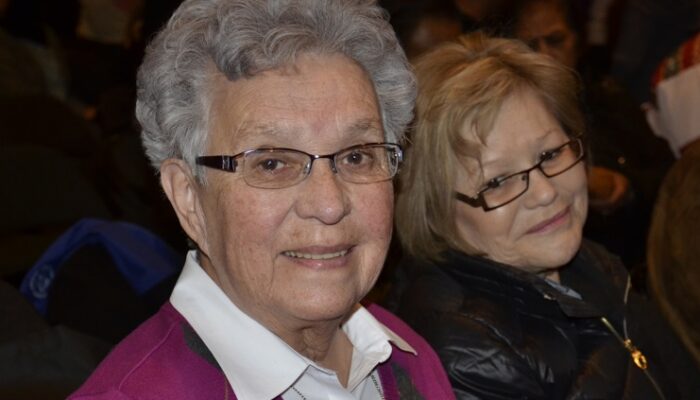 Survivor Dr. Sr. Dorothy Moore and Dr. Mali-Ellen Googoo attend the Truth and Reconciliation Commission (TRC) National Event in Edmonton, AB, March 2014.
Focus
This LE can be initiated or concluded with an ~11 minute video about Elder Ma’git Poulette’s doll (See Additional Resources)
Images and quotes are provided for printing on single sheets of 11×17 paper so that they can be hung around the classroom like a gallery. These images and quotes are meant to prompt learner responses: some gallery stops pose questions directly, others elicit responses all on their own.
Learners will record their responses to the gallery on a worksheet, following the prompts of Nemitekey (I see), Ankita’si (I think), We’tuo’tikey (I feel), Pemite’tm koqwey? (I wonder). Class discussion and sharing is essential with this LE, as residential school content can be emotional, and sometimes even disturbing. Many learners will relate to the children as children even if they are not survivors or descendants of residential school survivors.
PE!
It is extremely important that a note to guardians/parents be sent home ahead of this LE; the note should explain to parents that residential school content will be covered in this experience with the scheduled date and a method for parental/guardian communication.
While the LE is designed to be age appropriate and does not include the more traumatic residential school stories and content, the images or other text may trigger descendants of survivors.
Learner responses will vary depending on how much prior knowledge they have about Mi’kmaw history and culture. Educators can empower learners in this situation by reviewing the following content:
- The Mi’kmaq as the indigenous people of Nova Scotia and the Atlantic region.
- Mi’kma’kik as the ancestral homeland of the Mi’kmaq.
- The family as the heart of Mi’kmaw culture and practice.
- Understand the concepts of netukulimk and msɨt no’kmaq. (See LE F4)
- Mi’kmaw core cultural values. (See LE F8)
- The oral traditions inherent in Mi’kmaw culture and practice. (See LE F10)
- A basic understanding of Treaty Denial. (See Treaty Denial introduction)
LE Materials
COMING SOON!
 sharing our stories