Overview
Mi’kmaq were active and consistent protectors of treaty rights and responsibilities throughout the Treaty Denial period. To understand some of the issues Mi’kmaq faced during Treaty Denial, and how Mi’kmaq took steps to raise awareness of these issues, learners will read examples of historic petitions and letters written to Provincial and Crown authorities. They will create letters and petitions of their own—updated for modern audiences in an email or social media post format—related to selected topics including habitat destruction, mobility restrictions, assimilationist pressures, disease, and market opportunities.
Learners will...
- Consider carefully real letters written by Mi’kmaw leaders and individuals.
- Be exposed to a range of issues Mi’kmaq faced during the Treaty Denial period.
- Encounter Mi’kmaw agency and efforts to change the conditions of this difficult time.
- See that oral histories continued to be reflected in written correspondence to government officials.
- Be asked to write and think from a Mi’kmaw perspective on particular issues.
- Create possible strategies or solutions to a real historical issue.
Focus
In pairs, learners will read through provided examples of historic Mi’kmaw letters and petitions. Using these examples as inspiration, they will create their own formal advocacy emails or social media posts based on short summaries of a different issue (see supplementary materials). In their emails or posts, learners will 1) describe who they are and where they live; 2) describe their issue; and 3) make a request for a solution, or suggest first steps to solving their problem.
These guidelines may help learners with this experience:
- Suggesting strategies that would result in Mi’kmaw people changing who they are (aka, assimilation) is discouraged. Learners are encouraged to suggest solutions that allow Mi’kmaw practices and identity to thrive.
- Learners can share what they have already learned about Mi’kmaw practices in their emails or posts (e.g, netukulimk, the strength of oral histories, etc.)
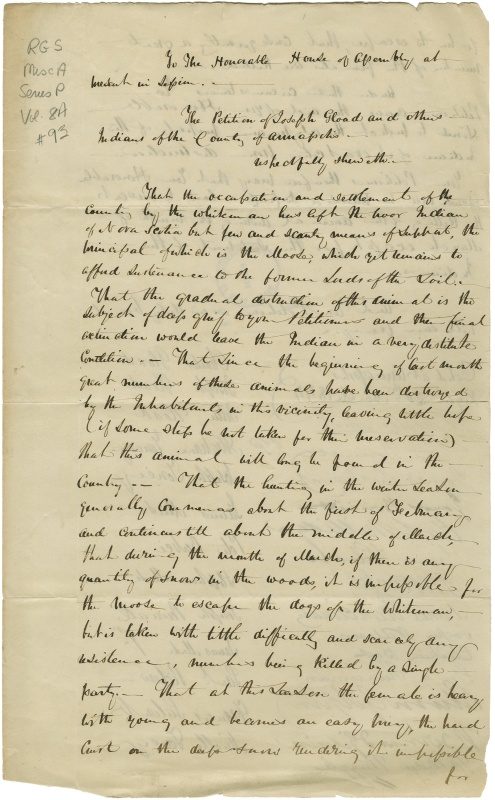
In 1844, Saqmaw Joseph Glode sent this petition to the Nova Scotia House of Assembly as part of his campaign to save moose populations across Kespukwitk from overhunting. In the petition, which was ultimately successful, Saqmaw Glode advocates for a closed moose hunting season for settlers, regulations for selling moosemeat, and the abolition of moose snares. Note that there are multiple spellings of this family name: “Glode,” “Gloade,” and “Gload.” The records are not consistent. (Credit: Nova Scotia Archives)
PE!
It is important that learners have a clear understanding of the following content:
- The Mi’kmaq as the indigenous people of Nova Scotia and the Atlantic region.
- Mi’kma’kik as the ancestral homeland of the Mi’kmaq.
- Mi’kmaw core cultural values such as family-based Mi’kmawey, netukulimk and msɨt no’kmaq. (See LE F4, F12)
- The oral traditions inherent in Mi’kmaw culture and practice. (See LE F10 and Family, Culture, Community introduction)
- That the Treaty Denial period is defined by British governance and culture denying the treaty agreements and by an overwhelming colonial experience of environmental and cultural disruption.
LE Materials
COMING SOON!
Additional Resources
See introduction to the Treaties section, as well as the general introduction to the resource.
 sharing our stories