Overview
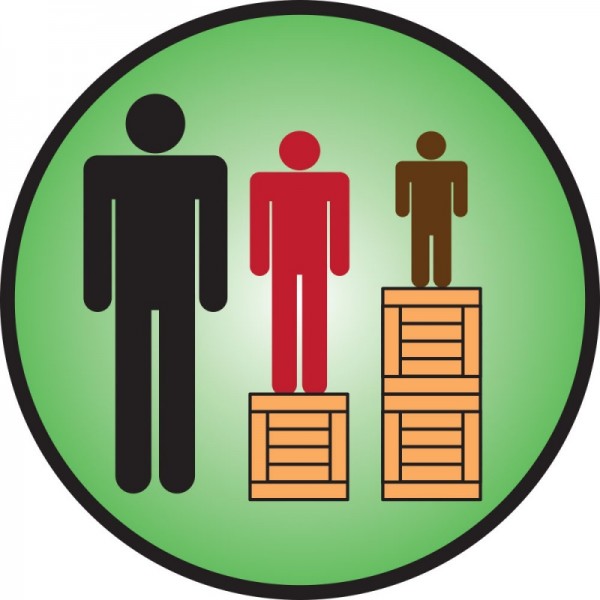
Many learners equate sameness with fairness: they believe that for conditions to result in fair outcomes, they need to arise from conditions that are the same. In this readers’ theatre, written by Melody Martin-Googoo,
learners will explore the difference between equality and equity. This is essential groundwork for understanding and realizing reconciliation.
Equality is achieved when conditions for people are designed to be the same. This is different than equity, which considers past experiences and other factors that impact a person’s or group’s ability to reach their own
goals. Equity is reached when challenges or barriers that keep people from participating the way they want to or achieving their own goals are removed or accommodated.
Learners will...
- Explore the differences between equality and equity as well as sameness and fairness.
- Understand that there are many origins to the diversity of disability and disadvantage among people and communities. Some of these are due to inherent physical, emotional, health or other kinds of disability; some are due to historical experiences where groups experienced sustained discrimination.
- Understand that history creates a variety of contexts for individuals and communities.
- Understand that treaties are historically-determined agreements that were meant to work out a compromise to historical realities rather than to create sameness among groups.
- Be encouraged to consider context prior to making judgments about fairness or equity.
Focus
The readers’ theatre content includes learner instructions as well as a general preface about its content, which compliments what is shared above. Note that the content has been designed for a range of reader strengths. The content also follows with a vocabulary list, discussion questions, ideas for extensions and important facts.
If educators want to involve more learners in the activity, they can consider the following:
- Have more than one cast and have casts take turns presenting their versions.
- Read several scripts in small groups then choose one to perform for the class.
- Split the narrator roles into more than one person (e.g., first half and second half).
PE!
It is important that learners have a clear understanding of the following content:
- The Mi’kmaq as the indigenous people of Nova Scotia and the Atlantic region.
- Mi’kma’kik as the ancestral homeland of the Mi’kmaq.
- The British and Mi’kmaq created treaties in the 18th century that endure to the present-day.
- That the Treaty Denial period is defined by British governance and culture that denied treaty agreements and by an overwhelming colonial experience of environmental and cultural disruption.
LE Materials
The materials below support this LE’s activities and knowledge growth. They are designed to be printed on both 8.5″x” and 11″x17″ paper.
 sharing our stories